Over the past decade, we’ve watched the taxi industry go through a seismic transformation. What was once dominated by street hails, handwritten logs, and radio dispatch has turned into a sophisticated digital ecosystem where rides are booked with a few taps, drivers are tracked in real time, and payments happen seamlessly in the background.
From our perspective, this shift is no accident. It’s the direct result of web app development reinventing how cab management systems operate end-to-end — something modern operators now achieve easily with support from Taxi Booking App Development Company expertise and CAB App Developers who understand the mobility ecosystem deeply.
We all remember the old experience. You’d call a taxi company, hear “15 to 20 minutes,” and end up waiting 45. You’d try to explain your location over a noisy call while standing in the rain. Dispatchers would repeat addresses over crackling radios, hoping a nearby driver heard it and responded.
The traditional cab management system was held together with paper, memory, and optimism.
Dispatchers sat in cramped offices with wall-mounted maps and whiteboards, manually tracking which drivers were free and where they might be. Payments meant fumbling for cash or hoping the card machine worked. Surge pricing, dynamic routing, rider analytics, lifetime value—these concepts weren’t just absent; they were unimaginable.
Did the system function? Yes, technically. But it was inefficient, frustrating, and left huge revenue and efficiency gains on the table for operators, while delivering a weak experience for riders. Something had to change—and web app development for Cab Management is what made that change possible.
The Digital Foundation: Why Web Apps Changed Everything
When we talk about cab management today, web applications sit at the core. Web apps brought one powerful idea to the industry: a unified, browser-based platform accessible from anywhere.
Instead of installing heavy software on individual desktops, operators can log into a cloud-based system through any browser—on a laptop, tablet, or even a phone. This evolution is exactly what businesses achieve when partnering with a Taxi Booking App Development Company capable of designing scalable, intuitive systems.
That small architectural shift had massive consequences:
- A fleet owner can check live performance and revenue from anywhere—even on a holiday.
- Dispatchers can work remotely without losing visibility into operations.
- Drivers can receive, accept, or reject jobs using their smartphones.
- Customers can book rides from any device without needing to install an app.
Behind the scenes, web apps consolidate what used to be fragmented systems: bookings, dispatch, billing, fleet management, driver performance, and customer data. Instead of information being scattered across diaries, spreadsheets, and disconnected tools, we now work with a single real-time source of truth for the entire operation.
Real-Time Tracking: The Game Changer
From our experience, one of the changes that truly flipped the industry was GPS-powered real-time tracking integrated into web apps.
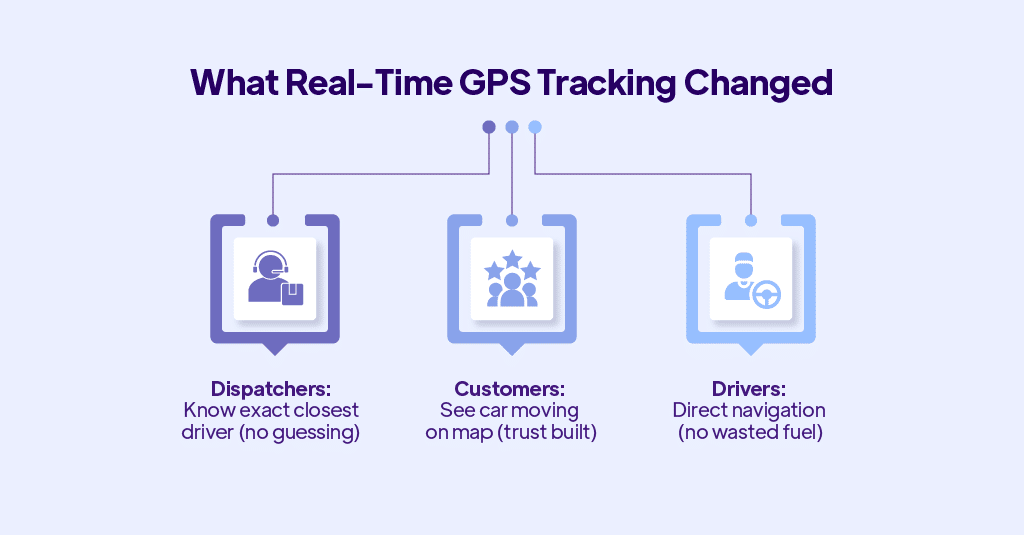
When every vehicle’s location is visible on a digital map, updated every few seconds, the entire operational model changes:
- Dispatchers don’t guess which driver is closest—the system knows.
- Customers aren’t left wondering if their cab is really coming—they see it moving on the map.
- Drivers don’t waste fuel circling blocks—navigation takes them directly to pickup and drop locations.
This single capability creates a ripple effect:
- Route optimization helps drivers avoid congestion and reduce travel time.
- Companies can verify that vehicles were at specific locations at specific times—crucial for dispute resolution, insurance claims, and corporate billing.
- Managers can identify patterns like unnecessary idling, inefficient routes, and areas of consistently high demand.
We’ve seen how that moving car icon on a map does more than just look nice: it builds trust. Customers know how far away their cab is, whether it’s actually on the way, and when they’ll likely be picked up. In the pre-digital era, that visibility simply didn’t exist.
Automated Dispatch: When Algorithms Outperform Humans
In legacy setups, dispatchers relied on memory, instinct, and guesswork. They tried to remember which driver was where, who just finished a ride, and who hadn’t had a job in a while.
With modern web-based dispatch systems, we let algorithms do the heavy lifting.
Today’s systems can:
- Match jobs based on proximity, driver ratings, vehicle type, and current traffic.
- Take into account historical demand patterns—like Friday nights, festival days, or rush hours.
- Pre-allocate drivers in anticipation of demand spikes in specific neighborhoods.
Studies across mobility platforms show that algorithm-led dispatch can reduce “empty miles” by up to 30%—the distance drivers travel without passengers. That has a compounding effect:
- Drivers earn more in the same number of hours.
- Customers get faster pickups.
- Fleets burn less fuel and emit fewer emissions.
- Operators get higher revenue per vehicle.
And what excites us most is that these systems learn continuously. With machine learning:
- They notice that certain zones spike in demand after office hours.
- They understand which drivers handle airport routes best.
- They anticipate congestion around stadiums during events.
Over time, the dispatch engine becomes smarter than any single human could be, simply because it’s learning from millions of historical data points.
Dynamic Pricing: Controversial but Transformative
We know surge pricing can be unpopular with riders, but from a systems perspective, dynamic pricing is one of the key levers that made modern cab operations sustainable at scale.
Before dynamic pricing, peak shortages were brutal. If it rained on a Friday night, good luck finding a cab. Supply and demand were completely out of sync.
With web apps, we can implement pricing models that adjust in real time based on:
- Active ride requests
- Available drivers
- Time of day and day of week
- Weather conditions
- Local events, public transport strikes, or disruptions
When we do this well, dynamic pricing:
- Encourages more drivers to go online during peak times.
- Spreads demand more evenly (some riders might delay non-urgent trips).
- Improves service availability when riders need it most.
For fleet managers, we’ve seen dashboard-driven pricing become a powerful tool. They can:
- Run time-bound promotions in low-demand slots.
- Offer discounts to high-value corporate clients in specific zones.
- Respond to competitor pricing in near real time.
This level of agility was impossible when prices were literally printed on stickers inside the vehicle.
Payment Integration: The Silent Revolution
If real-time tracking is the visible change, integrated digital payments are the hidden revolution.
Cash-based operations created endless friction:
- Drivers carried large amounts of cash, increasing risk.
- Customers worried about having exact change.
- Accounting teams battled reconciliation and leakage.
- Fraud and under-reporting were extremely hard to control.
With web apps, we’ve moved to fully integrated payment workflows:
- Customers store cards or wallets securely.
- Payments are processed automatically at the end of the ride.
- Digital invoices and receipts are generated instantly.
- Drivers don’t handle cash, reducing both risk and conflict.
And from a management point of view, this unlocks rich financial data:
- Every transaction is tied to distance, time, route, driver, and customer.
- We can analyze revenue per hour, per zone, per vehicle, per driver.
- Tax reporting, compliance, and audits become dramatically simpler.
On top of standard cards, we can integrate:
- Digital wallets and UPI-style payments
- Corporate accounts with monthly billing
- Referral credits and promo codes
- Split payments among passengers
This flexibility opens up new business models and makes the service more accessible to different customer segments.
Fleet Management Gets Smart
For operators managing tens or hundreds of vehicles, we’ve seen web-based fleet management turn chaos into clarity.
Within a modern web app, we can:
- Track maintenance schedules and service history per vehicle.
- Monitor fuel consumption and identify unusually high usage.
- Manage insurance renewals, inspection due dates, and permits.
- Get alerts before breakdowns rather than after.
On the driver side:
- We track on-time performance, ratings, safety incidents, and acceptance rates.
- We can identify top performers and drivers who need training.
- We can link incentives and bonuses to clear performance metrics.
Financially, web apps automate what used to require spreadsheets and manual effort:
- Driver payouts and commissions
- Vehicle-wise profitability
- Daily, weekly, and monthly revenue reports
- Expense mapping per vehicle or per route
When we layer utilization analytics on top, operators can see:
- Which routes and times generate the most revenue
- Which vehicles are underused
- Where to add more vehicles or reduce capacity
This data-driven view is one of the biggest differences between old-school cab depots and modern fleets.
Customer Experience: From Frustration to Delight
As riders ourselves, we know how dramatically the experience has changed.
Booking a ride is now a guided workflow rather than a phone call:
- Customers enter precise pickup and drop locations.
- They see upfront pricing or fare estimates.
- They choose vehicle types (standard, premium, XL, etc.).
- They can schedule rides in advance for airports or important meetings.
The communication layer is fully automated:
- Booking confirmations
- Driver assignment updates
- “Driver is arriving” notifications
- Post-ride receipts
No one has to call and ask, “Where is my cab now?” because all the information is already visible.
Rating systems add a layer of accountability:
- Customers rate drivers and trips.
- Drivers get feedback that helps them improve.
- Fleet managers can quickly identify repeated issues and intervene.
Where we’ve seen operators really win is in personalization:
- Remembering frequently used destinations
- Offering customized promotions
- Allowing users to favorite certain drivers
- Tailoring communication preferences (SMS, email, app notifications)
This is how a once-commoditized service becomes a relationship, not just a transaction.
Data Analytics: The Hidden Superpower
Every ride today is a mini dataset.
A typical trip captures:
- Pickup and drop points
- Route taken
- Time and duration
- Fare and tip
- Customer and driver identity
- Rating, wait time, and even weather context
Multiply this by thousands of rides a day, and we’re sitting on a goldmine of operational and strategic intelligence.
With web app analytics, we can answer questions like:
- Which zones are most profitable?
- When do we experience the longest wait times?
- Which drivers generate the highest repeat usage?
- Which campaigns actually translate into rides?
Using predictive analytics and machine learning, we can:
- Forecast demand by time, day, and area.
- Pre-position drivers in hotspots before demand spikes.
- Flag suspicious trips indicating potential fraud.
- Identify customers at risk of churning and trigger retention offers.
From our experience, operators who embrace data move from reactive firefighting to proactive planning, gaining a clear competitive edge.
Driver Empowerment—and New Challenges
Web apps haven’t just changed life for operators and customers; they’ve fundamentally reshaped the driver experience too.
On the positive side, drivers:
- Choose when to log in and work.
- See trip details upfront before accepting.
- Use integrated navigation for precise routing.
- Get paid automatically, without chasing cash.
We’ve also seen how real-time dashboards help drivers:
- Track their earnings by day, week, and month.
- Understand how acceptance rates or ratings affect demand.
- Optimize their own working hours for maximum income.
But this transparency can also create pressure:
- Constant rating visibility can be stressful.
- Algorithmic decisions about ride allocation or deactivation sometimes feel opaque.
The most responsible platforms we’ve worked with put in:
- Clear guidelines around ratings and deactivation.
- Support and appeals processes for drivers.
- Human oversight for critical decisions.
Driver onboarding has also become dramatically faster:
- Digital document upload
- Automated background checks
- Online training modules and quizzes
- Virtual orientations
Instead of weeks of manual processing, driver onboarding can often be completed in days—or even hours.
Integration Capabilities: Playing Well With Others
One of the big strengths of web applications is their ability to connect to other systems through APIs, and cab management is no exception.
We routinely see integrations like:
- Hotel apps that let guests book a cab directly from their room app.
- Event platforms that add “Book your ride” to confirmation emails or event pages.
- Corporate travel systems that include ground transport alongside flights and hotels.
On the data side, web apps integrate with:
- Mapping platforms (for traffic, POIs, and routes)
- Weather APIs (to predict demand spikes during storms or extreme temperatures)
- CRM tools (to unify customer profiles and lifetime value data)
- Accounting systems (for real-time financial reconciliation)
- BI tools (to build executive dashboards and complex reports)
The result is that a cab management system stops being a silo and becomes a transportation hub that plugs into broader urban and business ecosystems.
Scalability: Growing Without Growing Pains
Traditional on-premise systems forced operators to guess capacity and invest heavily upfront in servers and IT.
With cloud-based web apps, we design systems to scale elastically:
- When demand peaks—New Year’s Eve, holidays, events—the system can scale up.
- During normal or low-demand hours, capacity scales down to save costs.
This elasticity allows operators to handle massive surges without maintaining oversized infrastructure year-round.
Geographic scaling is also simpler:
- Expanding to a new city doesn’t require new installations.
- The same core platform supports multiple cities and regions.
- Central dashboards provide a unified view with region-level filters.
For small operators, subscription-based web apps remove the technology barrier to entry. They get the same sophisticated tools as large fleets, but without the outlay of building everything in-house.
Security and Privacy: The Responsibility We All Share
When we manage web-based cab platforms, we’re handling extremely sensitive data:
- Live and historical location data
- Payment credentials
- Contact details and identities of riders and drivers
- Travel patterns that reveal habits and routines
Modern web apps implement multi-layered security models:
- Encrypted data in transit (HTTPS/TLS)
- Secure, encrypted storage for sensitive fields
- Tokenized payment processing
- Role-based access control for staff
- Detailed audit logs for all critical actions
Privacy, however, goes beyond security. We also have to think carefully about:
- Data minimization – storing only what we need and for as long as necessary.
- Anonymization – using aggregated data for insights without exposing individuals.
- Compliance – aligning with frameworks like GDPR, CCPA, and local regulations.
The advantage of a web-based model is that when we build compliance features once, we can deploy them across the entire user base rather than treating each operator as an isolated case.
The Future: What We See Coming Next
Web app development is still evolving, and we see several powerful trends shaping the next wave of cab management innovation.
- AI everywhere
We’re moving from simple matching algorithms to deeper AI:- Natural language interfaces for voice-based booking and support.
- Computer vision for driver ID verification and vehicle inspection.
- Sentiment analysis on feedback to catch issues early.
- Electric fleets
As fleets electrify, web apps help:- Plan charging schedules.
- Track battery levels and range.
- Integrate with charging networks.
Managing EV fleets without software will be nearly impossible.
- Autonomous vehicles
As autonomy becomes real, web platforms will:- Orchestrate driverless fleets.
- Manage handoffs between autonomous and human-driven zones.
- Oversee edge cases that still require human intervention.
- Blockchain and smart contracts:
We may see:- Decentralized networks with direct rider–driver matching.
- Smart contracts automating payments and dispute resolutions.
- Token-based incentives and loyalty models.
- Augmented reality and voice
AR could guide riders to the correct pickup point or help them identify their vehicle. Voice-first interfaces could make the service more accessible to people who don’t want to navigate screens.
Case Study Title: Doubling Corporate User Acquisition for a Cab Platform
Overview
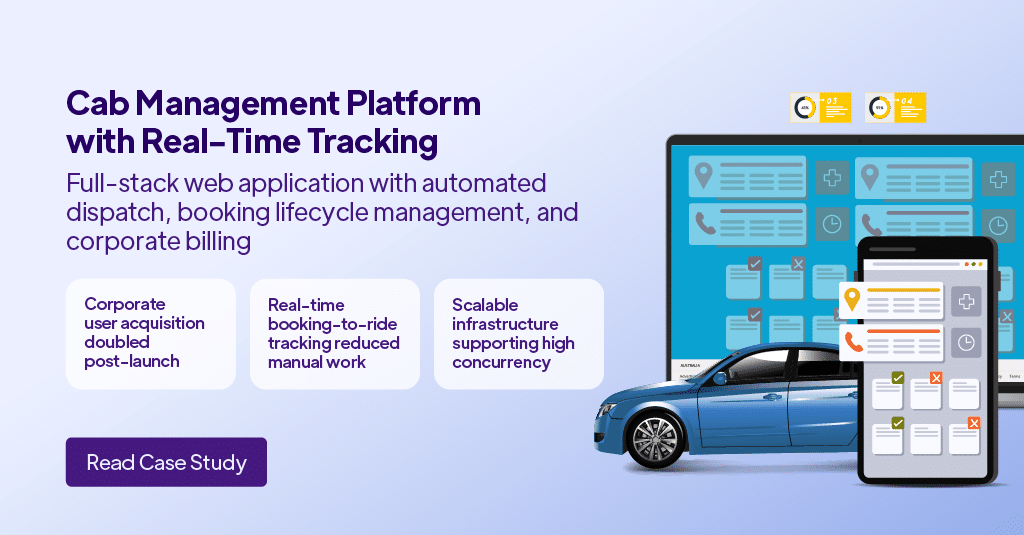
Zerozilla helped a cab-management startup transform its platform with a full-stack web application — combining a robust admin portal, automated workflows, real-time booking lifecycle tracking, and user-friendly interfaces — which resulted in a substantial increase in corporate user acquisition and platform growth.
Solutions
- Designed and developed a full-stack admin & management portal for the cab platform.
- Implemented end-to-end digital engineering: from front-end and back-end development to infrastructure and cloud deployment.
- Automated key workflows — booking, dispatch, billing — that formerly required manual intervention.
- Built real-time booking lifecycle management capabilities: bookings, vehicle assignment, tracking, and status updates in real time.
- Ensured quality via rigorous QA and secure, scalable cloud/IT infrastructure to support corporate operations.
Features
- Web-based admin portal for corporate clients and internal fleet operators.
- Real-time booking and ride lifecycle tracking (from booking → dispatch → ride → completion).
- Automated dispatch and allocation, reducing manual overhead and improving assignment accuracy.
- Integrated billing and payment workflows tailored for corporate clients, enabling transparent invoicing.
- Scalable cloud infrastructure to support growth in users and high concurrency.
Impact
- Corporate user acquisition doubled after launch of the web app and management portal.
- Significant reduction in manual work and administrative overhead for enterprise clients and fleet managers.
- Faster booking-to-ride cycles thanks to real-time dispatch and tracking, resulting in improved customer satisfaction and reliability.
- Enhanced scalability and stability, allowing the platform to onboard more corporate clients without performance issues.
Why It Matters
In a competitive mobility market, the difference between retention and churn often comes down to reliability, speed, and convenience. By migrating the cab platform to a well-architected web app with real-time booking lifecycle management, automated workflows, and corporate-friendly billing — we provided the foundation for sustained growth. Doubling corporate user acquisition shows how critical modern web development is for scaling transportation businesses and winning enterprise clients.
Read the full case study here: Taxi Booking App Development Company | CAB App Developers
The Bottom Line
From our vantage point, web app development hasn’t just improved cab management systems—it has reinvented them.
What once depended on dispatchers, wall maps, and cash is now:
- Data-driven
- Algorithm-optimized
- Customer-centric
- Scalable and globally accessible
The benefits touch every stakeholder:
- Customers enjoy transparency, reliability, and convenience.
- Drivers gain flexibility, higher earning potential, and professional tools.
- Operators get deep visibility, automation, and control.
- Cities benefit from better data and more efficient mobility networks.
What’s most striking to us is the compressed timeline. An industry that barely changed for fifty years transformed in about ten, driven by web applications that connected drivers, passengers, and management in real time.
By 2035, today’s platforms will likely look as dated as radio dispatch looks to us now.
And the lesson extends far beyond taxis. Any sector that involves coordinating people, assets, and information can undergo a similar transformation. Web applications give us the power to remove friction, make smarter decisions, and create experiences that feel natural, fast, and human.
The cab industry just happened to be one of the first to go through this revolution—but it definitely won’t be the last.