The streaming revolution shows no signs of slowing down; it’s accelerating in unexpected directions.
Currently, we’re watching something remarkable unfold across all OTT app development companies. However, the real story isn’t about revenue growth. It’s about the fundamental transformation happening in how platforms engage viewers, monetize content, and compete for attention.
As an entertainment app development company, we’ve built OTT platforms for clients across continents. What we’re seeing on the ground differs dramatically from what industry reports suggest.
The future of OTT app development companies isn’t about building another Netflix clone. It’s about understanding where technology, user behavior, and business models are converging to create entirely new entertainment experiences.
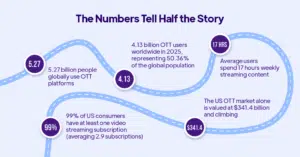
But the fact is that user patience is wearing thin. We’ve spoken with dozens of platform operators facing the same challenge;subscribers are demanding more for less.
The AI Revolution Isn’t What You Think
Everyone talks about AI-powered recommendations. Netflix reports that 80% of what users watch comes from their AI recommendation engine. That’s impressive but expected.
What’s actually changing the game? Contextual intelligence.
Modern AI in OTT platforms now handles:
Hyper-Personalized Content Discovery
AI analyzes watch patterns, search behavior, abandonment points, and engagement duration. Platforms are moving beyond “because you watched X, try Y” to “based on your mood, location, time, and past behavior, here’s what fits right now.”
Real-Time Video Quality Optimization
Adaptive bitrate streaming powered by AI reduces buffering by up to 35% during peak hours. This technology in entertainment app development services predicts network conditions and adjusts streaming quality before users experience disruptions.
Predictive Content Acquisition
We worked with a regional OTT app development company that used AI to predict which content would perform in their market. Instead of licensing everything, they strategically acquired titles based on viewer preferences, viewing patterns in similar demographics, and trending social media conversations. Their content acquisition budget efficiency improved by 28%.
Natural Language Search
Users can now search by saying “movies about time travel with a happy ending” or “cooking shows with Asian fusion recipes.” Natural Language Processing makes these complex queries work seamlessly.
The fascinating development? AI is starting to modify content in real-time. Platforms are experimenting with different pacing for action lovers versus drama enthusiasts; all from the same source material.
The Commerce-Content Collision
Something unexpected is happening at the intersection of entertainment and e-commerce.
For the entertainment app development services industry, shoppable video integration is transforming streaming from passive entertainment to active commerce. When we discuss this with clients, the initial reaction is usually skeptical. “Our audience wants to watch, not shop.
Then we show them the data.
Platforms integrating shoppable features report conversion rates 10x higher than traditional e-commerce. Why? Because context matters. Someone watching a cooking show who can immediately purchase the featured knife set is primed to buy. The purchasing intent already exists.
Major streaming platforms are now embedding product tags within content. Warner Brothers Discovery launched “Shop with Max,” allowing viewers to identify and purchase products featured in shows and movies via QR codes. Amazon Prime Video has integrated this natively across its platform.
FAST Channels: The Unexpected Winner
Free Ad-Supported Streaming Television (FAST) channels are experiencing explosive growth, and frankly, we didn’t see it coming.
The market went from a niche experiment to a $12 billion global market in 2025, projected to hit $34 billion by 2030 at a 23% compound annual growth rate.
Think about what’s happening: consumers are overwhelmed by subscription costs. The average US household juggles 2.9 paid subscriptions. Adding another $15/month service for one show isn’t appealing anymore.
FAST channels offer the familiarity of traditional television, scheduled programming, channel surfing, live broadcasts, without subscription fees. Platforms like Pluto TV, Tubi, and The Roku Channel have collectively captured 3.7% of total TV viewing time.
Tubi reached 100 million monthly active users as of June 2025. Pluto TV serves 80 million monthly users. These aren’t marginal services; they’re mainstream entertainment options.
FAST works because:
- No subscription friction for viewers
- Content owners monetize existing libraries
- Advertisers access engaged audiences with better targeting than traditional TV
- Platform operators build sticky destinations without massive content acquisition costs
The strategic opportunity? Niche FAST channels serving specific communities. Think 24/7 vintage car restoration programming. Or continuous chess tournament coverage. Audiences exist for incredibly focused content when it’s free and easily accessible.
The Multi-Screen Reality Nobody Planned For
Users don’t watch content on one device anymore. They start on mobile during commute, continue on tablets at home, and finish on smart TVs before bed.
59% of OTT consumption now happens via apps, up from 40% the previous year. Mobile and TV apps drove 1.5 billion viewing minutes compared to 871 million on web platforms.
But here’s the critical detail most platforms miss: TV app users attend 154% more live stream events than web users. Mobile app users attend 24% more events than website viewers.
When we build OTT platforms for entertainment app development companies, seamless multi-device synchronization isn’t a feature request; it’s table stakes. Users expect to pause mid-episode on their phone and resume seconds later on their TV, exactly where they left off, with viewing preferences, playlists, and watch history instantly available.
The technical complexity is real. You’re managing:
- Cross-device authentication
- Real-time viewing position sync
- Device-specific quality optimization
- Consistent UI/UX across form factors
- Progressive web apps for broader reach
Live Streaming’s Resurgence
Live content grew 45% year-over-year, primarily driven by sports and interactive events. This surprised many in the industry who assumed on-demand was the future.
People want shared experiences. Live sports, concerts, gaming tournaments, and interactive events create communal viewing that on-demand content cannot replicate.
We’re building platforms that blend live and on-demand seamlessly. Sports streaming clients want instant highlight generation, multi-angle viewing, and real-time statistics overlays. Music festival clients need multi-stage simultaneous broadcasts with viewer-controlled camera selection.
The technical demands for live streaming exceed on-demand significantly:
- Ultra-low latency (under 3 seconds)
- Massive concurrent viewer scaling
- Real-time transcoding for multiple quality tiers
- Interactive features (live chat, polls, reactions)
- Instant replay and DVR functionality
Disney+ Hotstar recorded peak concurrent viewership of over 5 million during major cricket matches. The infrastructure required to handle those spikes without service degradation is complex and expensive.
But live streaming opens unique monetization opportunities. Pay-per-view events, premium viewing angles, exclusive behind-the-scenes access, interactive betting integration, revenue per user for live events can exceed monthly subscription values.
The Hybrid Revenue Model Emergence
Pure subscription models are struggling. Pure advertising models lack predictability. The winning strategy? Hybrid.
AVOD (Ad-Supported Video on Demand) user penetration is forecast at 52.8% in 2025, growing to 61% by 2029. Subscription-based models still dominate revenue, but ad-supported tiers are growing faster.
We’re advising clients to build platforms with multiple revenue streams from day one:
- Tiered Subscriptions: Basic ad-supported tier free or low-cost, mid-tier with fewer ads, premium tier completely ad-free with exclusive content.
- Transactional Video on Demand (TVOD): Pay-per-view for premium events, early access windows, or exclusive content.
- In-Platform Commerce: Product sales, affiliate commissions, branded content partnerships.
- Creator Revenue Sharing: Platforms hosting creator content need monetization options that benefit both platform and creators.
Regional Content Is Winning
Global OTT app development companies assumed one content library would work everywhere. Wrong.
Regional platforms focused on local languages, cultural specificity, and domestic content are outperforming international giants in many markets. Asia-Pacific OTT consumption is growing 20% annually, largely driven by regional platforms.
Regional platforms win because:
- Content rights costs are lower for local content
- Cultural relevance drives higher engagement
- Less competitive pressure from global players
- Underserved audiences willing to pay premium prices
- Community building around shared cultural identity
The strategic lesson: don’t try to be Netflix for everyone. Be the definitive platform for a specific community, language, genre, or region.
Technology Stack Evolution
The platforms we’re building today differ dramatically from three years ago. Through our entertainment app development services, we’ve refined our approach to building robust, scalable streaming solutions that meet modern viewer expectations.
Frontend Technologies
React.js, Angular, and Vue.js for responsive, fast interfaces that work across devices. Progressive Web Apps extending reach without app store dependencies.
Backend Architecture
Node.js and Python (Django/Flask) for robust server-side logic. Microservices architecture enabling independent scaling of different platform components.
Cloud Infrastructure
AWS, Azure, and Google Cloud providing scalability and reliability. Edge computing reducing latency for global audiences.
CDN Integration
Content Delivery Networks like Cloudflare and Akamai ensuring fast, reliable streaming worldwide.
AI/ML Integration
TensorFlow and PyTorch powering recommendation engines, content analysis, and predictive analytics.
Adaptive Bitrate Streaming
HLS (HTTP Live Streaming) and DASH (Dynamic Adaptive Streaming over HTTP) protocols ensuring optimal quality across varying network conditions.
The cost to build a professional OTT platform varies enormously:
- Basic streaming platform: $50,000-$150,000
- Advanced custom platform with AI: $150,000-$500,000+
- Enterprise-scale solution: Several million dollars
What determines cost? Feature complexity, concurrent user capacity, content management requirements, custom AI integration, multi-region deployment, and third-party service integrations.
We’re seeing more clients opt for phased development. Launch with core features, gather real user data, then expand based on actual behavior rather than assumptions.
The Compliance and Security Maze
Content security concerns keep platform operators awake at night.
Digital Rights Management (DRM), watermarking, and anti-piracy measures are non-negotiable for premium content. Studios won’t license content without robust protection.
Multi-layered security involves:
- DRM Integration: Widevine, FairPlay, and PlayReady protecting content across devices
- Forensic Watermarking: Tracking leaked content back to specific accounts
- Geo-Blocking: Restricting content based on licensing territories
- Multi-Factor Authentication: Preventing account sharing abuse
- Session Management: Detecting and limiting concurrent streams
Regulatory compliance adds complexity. GDPR in Europe. COPPA for platforms serving children. Regional content restrictions. Tax implications across jurisdictions.
One platform we launched faced last-minute regulatory hurdles in their target market requiring age verification systems, localized content ratings, and government reporting capabilities. These weren’t initial requirements but became mandatory before launch.
Build compliance into architecture from the start. Retrofitting is exponentially more expensive and disruptive.
What the Future Holds
Based on current client conversations and market signals, here’s what’s coming:
- Emotion-Aware Recommendations
AI analyzing facial expressions, viewing patterns, and biometric data (with permission) to suggest content matching current mood. Testing shows 60% higher engagement when mood matching works correctly. - Voice-Controlled Experiences
“Find that movie with the lawyer who was innocent” works better than browsing menus. Voice integration is moving beyond simple search to full platform navigation. - Blockchain-Based Rights Management
Transparent, automated royalty distribution for creators. Smart contracts executing payments when content is viewed. Early implementations show 40% reduction in rights management overhead. - Social Viewing Features
Watch parties with synchronized playback, shared reactions, and integrated chat. The pandemic proved people want communal viewing experiences even when physically separated. - Interactive Storytelling
Viewers influencing plot direction, character decisions, and story outcomes. Gaming mechanics applied to video content. Early experiments show viewers spend 3x longer with interactive content.
The Uncomfortable Truth About OTT
Here’s what we tell every client: building the platform is the easy part.
Content acquisition, marketing, customer retention, and profitability, those challenges dwarf technical development. Hundreds of OTT platforms launch yearly. Most fail within 18 months.
Why? They underestimate:
- Content licensing costs (typically 30-50% of revenue)
- User acquisition costs (often $20-50 per subscriber)
- Churn rates (industry average 35% annually)
- Technical infrastructure at scale (server costs spike with usage)
- Ongoing content refreshment needs (users expect new content continuously)
The successful platforms we’ve worked with share common traits:
Clear Niche Focus
They serve specific audiences exceedingly well rather than trying to be everything to everyone.
Multiple Revenue Streams
They don’t rely solely on subscriptions. Commerce, advertising, events, and premium features diversify income.
Community Building
They create reasons for users to return beyond content consumption. Forums, user-generated content, live events, and social features drive engagement.
Ruthless Analytics
They measure everything. Watch time, abandonment points, feature usage, conversion funnels, cohort retention. Decisions are data-driven, not assumption-based.
Iterative Development
They launch quickly with core features, gather real usage data, then expand strategically based on actual user behavior.
Case Study: Custom OTT Platform for Regional Streaming
Overview
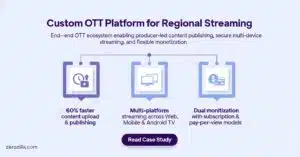
Zerozilla built a scalable OTT platform that enables independent producers to upload, manage, and monetize regional content across mobile, TV, and web—without technical dependency. Delivered in 12 weeks, the solution ensures secure playback, smooth streaming, and flexible monetization.
Solutions Implemented
- Cross-platform OTT apps for Android, iOS, Android TV, and web
- Producer-first CMS for self-service content management
- Dual monetization: subscription and pay-per-view
- DRM-enabled single-view playback with restricted controls
- Centralized admin portal for platform management and analytics
Key Features
- One-click content upload with metadata tagging
- Multi-device streaming experience
- Secure, controlled playback
- Flexible revenue models
- Scalable backend architecture
Impact Delivered
- 60% faster content publishing
- Full content and revenue control for producers
- Seamless, secure streaming across devices
- Reduced operational and developer dependency
Why It Matters
This platform empowers regional creators with a secure, scalable way to distribute and monetize content while delivering a premium viewing experience to audiences across devices.
Read full case study: Custom OTT Platform | Entertainment App Development Services
Building for 2026 and Beyond
The platforms winning in 2026 aren’t just streaming services; they’re entertainment ecosystems.
They blend watching, shopping, socializing, and participating into cohesive experiences that keep users engaged far longer than passive content consumption alone.
When we architect these platforms, we’re thinking about:
- How does this facilitate discovery beyond algorithmic recommendations?
- What creates shared experiences among viewers?
- Where do commerce opportunities feel natural, not forced?
- How can creators monetize beyond views?
- What makes users return even when not consuming content?
The technology enabling these experiences exists today. AI, cloud infrastructure, advanced analytics, real-time personalization; it’s all available and proven. The real challenge is strategy: understanding your specific audience deeply, identifying unmet needs in the market, and building experiences that solve real problems better than alternatives.
One final observation from building dozens of these platforms: the most successful aren’t the ones with the biggest budgets or most features. They’re the ones that understand their users so well that every decision, from content selection to interface design to monetization strategy, aligns perfectly with what that specific audience actually wants.
The future of OTT isn’t about competing with Netflix or Disney+. It’s about identifying underserved audiences and creating tailored experiences that delight them specifically.
That’s the opportunity in 2026 and beyond.
As a specialized entertainment app development company, we’ve built OTT solutions for media companies, content creators, broadcasters, and entrepreneurs across multiple industries and geographies.
Bring your platform to life with cutting-edge technology and strategic insights. Let’s discuss your streaming vision.