Recently, a student experience survey found that 75% of students prefer accessing all university services through a single campus recruitment software solution, yet most institutions still operate across multiple disconnected systems. Nearly half of the students reported missing important deadlines simply because they couldn’t find the right information in time.
Pause for a moment and think about that.
Not because they didn’t study.
Not because they didn’t care.
But because the systems meant to support them were fragmented.
Now consider the administrative side. Many universities still manage admissions in one system, academics in another, finance in a third, career services in a fourth, and alumni relations somewhere else entirely. Faculty toggle between tools. Advisors rely on spreadsheets. IT teams spend more time integrating patches than enabling innovation.
The problem isn’t technology adoption.
It’s technology fragmentation.
And that is precisely where integrated platforms change the equation.
Fragmented vs Integrated
Scenario 1: The Fragmented Campus
A second-year engineering student needs to:
- Check grades
- Pay fees
- Book a career counseling session
- Submit internship documentation
- Access learning materials
Each task requires a different login. Each system has a different interface. Notifications arrive through email, WhatsApp groups, and separate portals. Deadlines are buried.
On the administrative side:
- The registrar doesn’t have real-time financial clearance data.
- Career services cannot see academic performance indicators.
- Faculty cannot access placement engagement history.
Data exists — but it doesn’t talk to itself.
Scenario 2: The Integrated Campus
Now imagine the same student using a unified digital platform:
- One login
- Personalized dashboard
- Automated deadline reminders
- Integrated academic + finance + placement workflows
- Real-time advisor visibility
Faculty see early warning signals. Career teams track internship pipelines. Leadership views retention metrics in one dashboard.
The difference isn’t convenience.
It’s institutional intelligence.
The Reality: Digital Expectations Have Changed
Today’s students compare university digital experiences not to other universities — but to Netflix, Amazon, and Google.
Meanwhile, higher education globally faces:
- Enrollment pressures
- Budget constraints
- Rising competition
- Increased demand for employability outcomes
Universities cannot afford inefficiency at scale.
What Is an Integrated Platform?
An integrated platform in higher education is not just a bundled software solution. It is a connected ecosystem where the below are unified through shared data architecture.
- Student Information Systems (SIS)
- Learning Management Systems (LMS)
- Finance & billing
- CRM and admissions
- Career services
- Alumni engagement
- Analytics and reporting
A custom web application for universities creates a single source of truth across the student lifecycle.
From prospect → applicant → enrolled student → graduate → alumnus.
Why This Matters More Than Ever
1. Retention Is Now a Strategic Priority
Retention isn’t just academic — it’s financial.
A 5% increase in retention can translate into millions in preserved tuition revenue for mid-to-large institutions.
Integrated platforms enable:
- Early alert systems
- Predictive risk modeling
- Proactive advising
- Centralized intervention tracking
When academic, attendance, financial, and engagement data merge in a custom web application for universities, at-risk students become visible earlier.
2. Administrative Efficiency Is Breaking Point Critical
Universities globally report growing administrative workload without proportional staffing increases.
Integrated platforms reduce:
- Manual data reconciliation
- Duplicate entry
- Email-based workflow approvals
- Spreadsheet-based reporting
Institutions implementing automation within unified systems have reported:
- Up to 70% reduction in manual processing tasks
- Enrollment processing improvements of 75–85%
- Significant reductions in IT system maintenance overhead
This is not incremental efficiency. It is structural transformation.
3. Recruitment and Career Outcomes Demand Integration
Campus recruitment is no longer an isolated department activity. It directly influences rankings, brand reputation, and enrollment demand.
An integrated recruitment ecosystem allows:
- Real-time student eligibility tracking
- Employer engagement dashboards
- Automated placement workflows
- Data-driven performance reporting
Career services gain visibility into academic progress. Faculty align curriculum with industry trends. Leadership tracks placement outcomes in unified dashboards.
Without integration, placement data often lives in silos — limiting institutional strategy.
Case Insights: What Leading Institutions Are Doing
Digital Student Success Hubs
Several universities have adopted centralized student success platforms integrating advising, analytics, and communication systems. Institutions using such systems report:
- Improved student engagement
- Better advisor-student response cycles
- Graduation rate increases between 3–15%
These outcomes are not accidental — they stem from connected data.
Smart Campus Models
Globally, forward-thinking universities are implementing “smart campus” ecosystems where:
- Attendance data feeds predictive models
- AI tools recommend academic support
- Mobile apps integrate ID, payments, and academic resources
- Leadership dashboards provide real-time institutional health metrics
These campuses operate less like administrative departments — and more like data-driven enterprises.
The Financial Argument: ROI Beyond IT
Many institutions view integration as an IT cost center.
But integrated platforms influence:
- Retention revenue
- Enrollment yield
- Placement success rates
- Alumni engagement
- Operational cost efficiency
When universities treat integration as a strategic investment rather than a software purchase, the ROI becomes clearer.
Consider this:
If a 10,000-student university improves retention by just 2%, the financial impact can outweigh platform costs within a year.
Integration directly protects revenue streams.
Faculty and Staff Experience: The Overlooked Factor
Technology fatigue among faculty is real.
Multiple logins, disconnected grade systems, inconsistent communication tools — all add friction.
Integrated platforms:
- Centralize teaching resources
- Automate administrative tasks
- Improve cross-department visibility
- Enable data-backed academic planning
When faculty workload decreases, teaching quality improves.
Data-Driven Leadership
One of the most transformative aspects of integration is executive visibility.
Leadership gains access to:
- Enrollment funnel analytics
- Student progression tracking
- Financial forecasting dashboards
- Placement performance metrics
- Real-time compliance indicators
Instead of waiting for quarterly reports compiled manually, decision-makers operate with live intelligence.
This changes institutional agility.
The Challenges — and Why They’re Worth It
Integration does require:
- Change management
- Stakeholder alignment
- Strong data governance
- Phased implementation
Resistance often stems from comfort with legacy systems.
However, maintaining fragmented systems often costs more long-term — both financially and strategically.
The Future: AI + Integration
The next phase of higher education technology will not be more tools.
It will be smarter ecosystems.
AI layered onto integrated platforms enables:
- Personalized academic pathways
- Automated advising prompts
- Predictive enrollment targeting
- Intelligent career matching
With integration, AI becomes transformative.
Key Questions for University Leaders
If you are evaluating your institution’s digital maturity, ask:
- Can we see a complete student profile in one place?
- Do departments share real-time data?
- How many systems require separate logins?
- How much time is spent reconciling reports manually?
- Are we using predictive analytics for retention?
If the answers reveal fragmentation, integration is no longer optional.
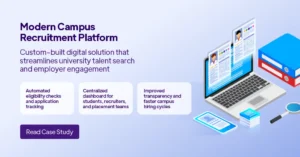
Case Study: Modernizing University Talent Search with a Custom Platform
Overview:
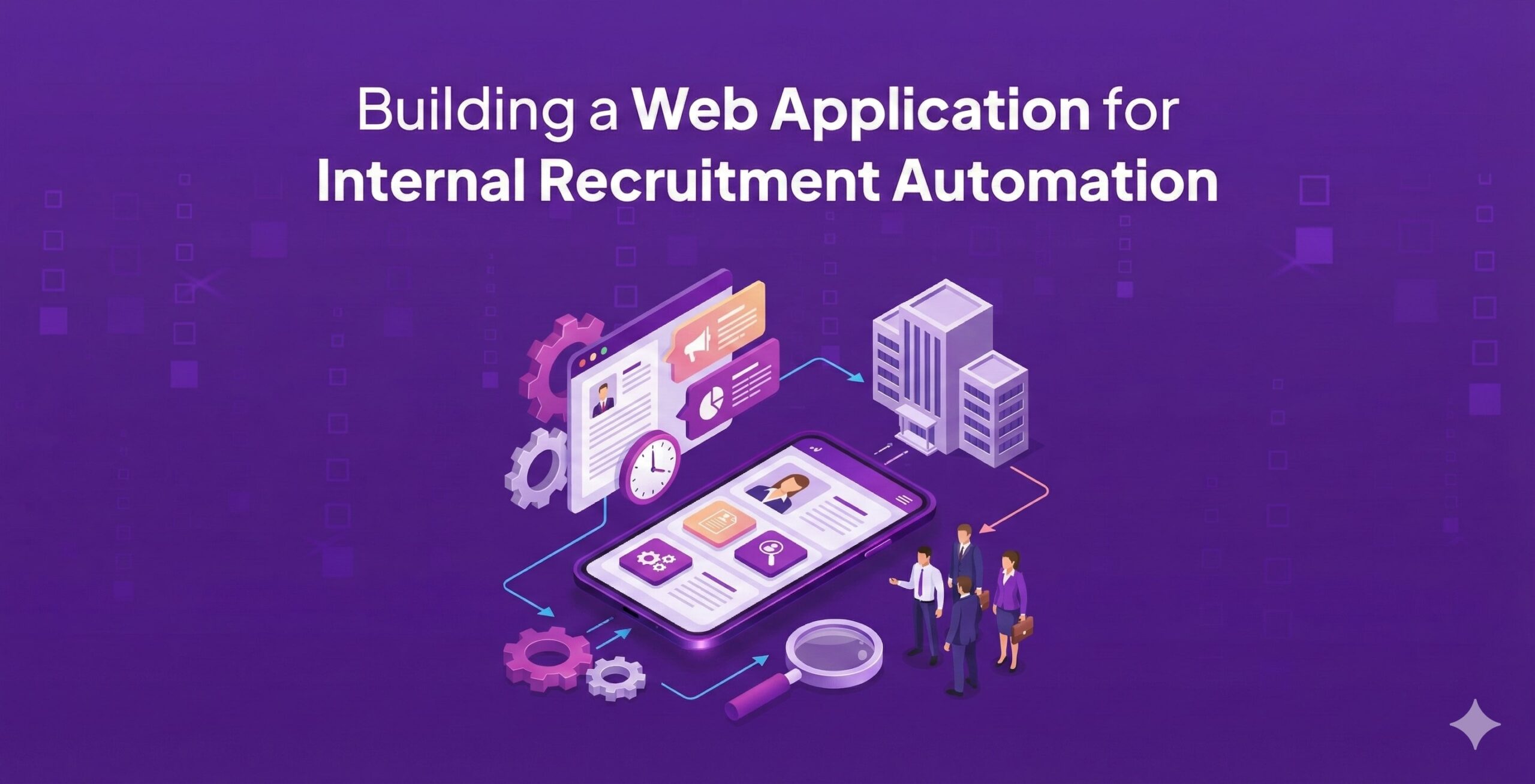
A university sought to streamline its campus recruitment process, which relied heavily on manual coordination, emails, and spreadsheets. The goal was to build a centralized campus recruitment software solution to simplify employer engagement, student applications, and placement tracking.
Solution:
- Developed a custom web-based recruitment platform to digitize and automate placement workflows.
- Enabled employer job postings, automated student eligibility checks, and real-time application tracking.
- Centralized communication and reporting within a single system.
Features:
- Unified dashboard for managing companies, drives, and applications.
- Automated eligibility filtering and shortlisting tools.
- Real-time status tracking for students and recruiters.
- Centralized database for student records and placement analytics.
Impact:
- Reduced manual workload and administrative delays.
- Improved transparency across students, recruiters, and placement teams.
- Accelerated hiring cycles with structured workflows.
- Delivered a scalable system to support growing placement demands.
Why It Matters:
By replacing fragmented processes with an integrated campus recruitment software solution, the university enhanced efficiency, visibility, and student placement outcomes—transforming campus recruitment into a data-driven, scalable ecosystem.
Final Thoughts: From Systems to Ecosystems
Higher education is no longer operating in a predictable environment.
Enrollment volatility, global competition, digital-native students, and employability expectations demand smarter infrastructure.
EdTech software development companies develop integrated platforms not just for convenience.
They are about resilience.
They are about intelligence.
They are about sustainability.
Universities that move from disconnected systems to unified ecosystems position themselves to:
- Improve student success
- Strengthen operational efficiency
- Increase institutional agility
- Enhance competitive positioning
The question is no longer whether to integrate. It is how quickly you can.