“We have 47 open positions, 892 applications to review, and I just spent two hours trying to figure out which candidates we’ve already interviewed.”
That’s what an HR director told us three years ago, dropping a stack of printed resumes on our conference table. He looked exhausted. That conversation sparked a transformation that would fundamentally change how dozens of our clients approach web app development for HR management.
Let’s explore why building a custom web application for internal recruitment automation isn’t just another IT project—it’s a strategic investment that pays dividends in ways you might not immediately expect.
The Problem Was Bigger Than We Realized
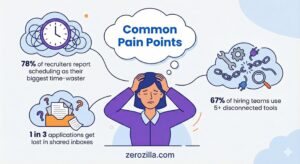
When we started analyzing their recruitment process, what we discovered was shocking. The HR team spent 23 hours per week on manual data entry alone. Picture this: copying information from email applications into spreadsheets, then transferring it into their aging applicant tracking system, then manually updating hiring managers via even more emails. It was like watching someone use a spoon to empty a swimming pool.
The numbers told a brutal story. While the average cost per hire nationally was $4,700, theirs was pushing $7,200. Their time-to-fill averaged 67 days compared to the 44-day benchmark. They were hemorrhaging both money and opportunities.
Here’s what we consistently see when it comes to web app development for HR management:
- Fragmented Applications: One client discovered 34 “lost” applications sitting in a shared inbox nobody checked regularly. Those weren’t just numbers—they were real people who might have been perfect for open roles.
- Manual Data Entry Hell: We watched one recruiter spend 12 minutes copying information from a single resume. Multiply that by hundreds of applications, and you’re talking about days vanishing into copy-paste purgatory. Industry data suggests recruiters spend 15-25 hours weekly on tasks a computer could do in seconds.
- Scheduling Nightmares: We’ve seen email threads with 27 messages just to schedule one interview. “Can you do Tuesday at 2?” “No, but Wednesday at 10 works.” And on it goes. One hiring manager told us she spent more time scheduling interviews than conducting them.
- Inconsistent Evaluations: Without structure, feedback collection becomes chaos. Some hiring managers send detailed assessments within hours. Others send two-sentence emails three days later. Try comparing candidates when one interviewer uses a 10-point scale and another writes prose essays.
- Integration Gaps: We worked with one company using seven different systems that didn’t talk to each other. They literally paid someone whose primary job was transferring data between systems. They were paying a professional salary for a human API.
Why We Build Custom Instead of Buying Off-the-Shelf
Here’s what we’ve learned: off-the-shelf web applications for internal recruitment solutions are built for the broadest possible market, meaning they’re simultaneously too complex and too limiting. We’ve watched businesses pay $50,000 annually for platforms with 200 features when they only need 30. Meanwhile, the five workflows that would actually transform their process? Not available.
One client showed us their commercial platform with an entire module for “competency mapping” that nobody understood. But it couldn’t sync interview feedback to their HR system—the one feature they desperately needed. It’s like buying a Swiss Army knife with 47 tools when all you need is a good blade and can opener, except the can opener doesn’t work.
Enterprise platforms typically cost $35,000-$60,000 annually. Custom web app development for HR management requires $100,000-$200,000 upfront. That’s real money. But here’s the math we ran with one client over five years: Their old commercial platform would have cost $280,000 in licensing plus $45,000 in integration work. The custom solution cost $165,000 upfront and $25,000 annually for maintenance. By year three, they were ahead. By year five, they’d saved over $150,000 while having a system that actually worked their way.
How We Build These Systems
We build web application for internal recruitment with React on the frontend and Node.js on the backend. But what does that actually mean for users?
React gives us component-based architecture—think LEGO blocks for user interfaces. We build reusable pieces like candidate cards, scheduling widgets, and evaluation forms, then combine them differently for various departments. One client needed five departmental workflows; we handled it by mixing about 30 core components in different configurations.
The single-page application design means no jarring page reloads. Click on a candidate profile? Details slide in smoothly. Jump to scheduling? Instant transition. User satisfaction scores jumped 40% after one client migrated from their old page-by-page system.
We enable offline functionality using service workers. A hiring manager on a plane can review candidates and complete evaluations without WiFi. Everything syncs automatically when they reconnect. One executive completed an entire day’s candidate reviews during a cross-country flight.
Node.js handles the backend with an event-driven architecture that manages concurrent operations beautifully. When 50 users access the system simultaneously—some running reports, others uploading resumes, others scheduling interviews—Node.js handles it all efficiently. We’ve had systems support 200+ concurrent users without breaking a sweat.
We typically use PostgreSQL for databases because recruitment involves intricate relationships—candidates linked to positions, positions to interviewers, interviewers to evaluations. This maps naturally to relational databases.
For real-time features, we use WebSocket technology. When a candidate applies at 2 PM, the hiring manager sees the notification within seconds. When interview feedback is submitted, the recruiter gets an immediate alert. One hiring manager told us this alone saved her 30 minutes daily because she wasn’t constantly refreshing her browser.
The Features That Actually Matter
Automated Resume Parsing: A candidate submits a five-page PDF resume. The system reads it and automatically extracts their information, then normalizes everything into consistent formats. One client manually entered data from 150 resumes weekly. After implementing parsing, that dropped to reviewing about 20 flagged items. They reclaimed roughly 18 hours weekly.
Intelligent Scheduling: Remember those 27-email threads? The scheduling engine eliminates them entirely. We integrate with Microsoft 365 and Google Workspace using OAuth-based authentication, accessing availability without exposing private calendar details.
Here’s a real example: We needed to schedule a panel interview with three interviewers across two time zones. One had back-to-back meetings every Tuesday and Thursday. Another refused anything before 10 AM. The third preferred video on Fridays. The web app development for HR management system analyzed all constraints, found three possible slots, ranked them, and the recruiter picked one. Total time: 90 seconds. The old way would’ve taken a dozen emails and two days.
Workflow Automation: We set up automated emails triggered by specific events—application received, interview scheduled, decision made. But these aren’t generic robot emails. They’re personalized with dynamic fields: candidate names, position details, interview specifics. One hiring manager includes a personal note in every interview invitation. The system pulls her note and includes it seamlessly. It feels personal because it is—we just automated the mechanical parts.
Structured Evaluations: We help organizations define specific competencies for each role. Then interviewers rate candidates against standardized criteria. As evaluations are submitted, the system immediately calculates aggregate scores, identifies consensus patterns, and flags strong candidates.
One hiring manager told us: “I can now see in 30 seconds what used to take me 45 minutes of comparing spreadsheets.”
Integration Is Everything
Recruitment platforms deliver maximum value when they talk to your existing systems. Isolation is the enemy.
When positions are approved in your HRIS, job details automatically populate the recruitment platform. When offers are accepted, candidate information flows into the HRIS, triggering onboarding workflows. One client saved 12 hours monthly just on new hire data entry.
We integrate with enterprise identity providers like Okta and Azure AD using SSO. Users access the recruitment platform with their existing credentials—no additional passwords to remember or reset.
Security and Compliance
Recruitment systems handle sensitive personal information, so we take security seriously. We implement role-based permissions ensuring users access only relevant information. Recruiters see their assigned positions. Hiring managers see their departments only. Executive searches can be kept confidential from most recruiters.
All data transmission uses TLS 1.3 encryption. Sensitive information like social security numbers is encrypted at rest using AES-256. We build in GDPR compliance tools, EEOC compliance features, and comprehensive audit logging. One client facing a discrimination claim used their audit logs to show exactly who accessed which information when, providing clear documentation for their defense.
Real Results
We target specific performance benchmarks: initial page loads under 2 seconds, API responses in 100-300 milliseconds, resume parsing in 3-5 seconds, scheduling calculations in 1-3 seconds regardless of complexity.
The analytics capabilities enable continuous improvement. One client discovered their engineering time-to-fill was 83 days while sales was 42 days. That insight led them to investigate and implement changes that brought engineering down to 58 days.
Another client discovered their applicant pool was 45% women, but only 22% of hires were women. The drop-off happened primarily at the interview stage. They used this insight to implement interviewer training and structured evaluations that reduced bias.
Implementation: Take It Phase by Phase
We strongly recommend phased rollouts rather than big-bang deployments web app development for HR management. We once tried launching everything on day one. It was a disaster. Users were overwhelmed, training was inadequate, adoption suffered. Now we always phase rollouts, and the difference is dramatic.
Phase 1 focuses on core functionality—application management, candidate database, basic workflows. This establishes the foundation without overwhelming users. Phase 2 adds advanced automation like scheduling and parsing once users are comfortable. Phase 3 implements enterprise integrations and advanced analytics.
We involve stakeholders early to ensure the system reflects actual needs and builds ownership. People support what they help create. We provide role-specific training, pilot programs with volunteer departments, and dedicated support during initial deployment.
Case Study: React-Powered Internal Recruitment Automation
Overview:
The project involved building a custom web application using React to automate and streamline internal recruitment workflows. The goal was to replace manual, error-prone hiring processes with a digital solution that simplifies candidate screening, tracking, and recruitment management — delivering a faster, more organized, and efficient hiring process for the company.
Solution:
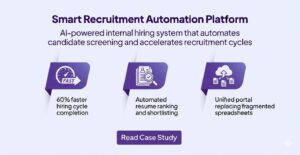
- Developed a web-based recruitment platform using React to manage internal hiring.
- Automated candidate tracking and screening processes, reducing reliance on manual spreadsheets or emails.
- Implemented user-friendly interfaces and workflows to simplify recruiter and hiring-manager tasks.
- Integrated mechanisms for application submission, status updates, and candidate evaluation through the app (centralizing recruitment data).
Features:
- Dashboard for recruiters/hiring managers to view and manage job applications.
- Candidate screening and shortlisting tools to help select suitable applicants efficiently.
- Status tracking: ability to monitor application progress and update statuses as candidates move through stages.
- Centralized data storage for all candidate information, hiring histories, and recruitment metrics — enabling better oversight and transparency.
Impact:
- Significantly reduced manual effort and administrative overhead in the recruitment process.
- Improved speed and reliability of internal hiring cycles by replacing fragmented tools/processes with a unified platform.
- Enhanced visibility and transparency into candidate status and hiring workflows, aiding better decision-making.
- Delivered a scalable solution — easier to manage increasing volume of applications without proportionally increasing HR resources or errors.
Why it matters:
In many organizations, recruitment remains a cumbersome mix of spreadsheets, emails, and ad-hoc processes — leading to inefficiencies, delays, and poor candidate experiences. By building a custom, automated recruitment application, the company not only streamlines internal hiring but also ensures scalability, consistency, and data-driven oversight. This matters because it transforms HR from a reactive, admin-heavy function into an efficient, strategic part of the business — reducing cost, time, and friction, which ultimately helps attract better candidates and improve organizational growth.
The Bottom Line
If you’re considering custom web app development for HR management, start by deeply understanding your current process. Involve stakeholders from the beginning. Focus on the problems that matter most. And be prepared to iterate based on real-world feedback.
Don’t try to automate everything at once. Remember that technology is a tool, not a solution. The best recruitment automation amplifies human capabilities rather than replacing human judgment. It eliminates busywork so your team can focus on what humans do best: building relationships, evaluating cultural fit, and making nuanced decisions that require empathy and insight.