In B2B, relationships are everything.
As a B2B portal development company, we have built self-service portals for manufacturers, SaaS providers, logistics companies, healthcare distributors, and industrial suppliers.
Our CRM software developers can vouch that every engagement starts the same way:
“We need a portal so customers can download invoices and track orders.”
But six months after launch, the conversation changes.
“Our clients are more engaged.”
“Support tickets dropped by 38%.”
“We’re having better conversations with accounts.”
“Renewals are smoother.”
What began as a digital efficiency project becomes a relationship transformation.
From our experience as a CRM software development company, a B2B self-service portal is not just a software layer. It’s a relationship infrastructure.
Let’s break down why.
How Has B2B Customer Expectations Shifted?
Reactive service models do not excite B2B customers anymore. Decision-makers, procurement managers, and operations teams expect:
- 24/7 access to account information
- Faster issue resolution
- Transparent pricing and billing
- Real-time order tracking
- Seamless communication
Modern buyers prefer solving routine issues independently.
If businesses fail to provide digital autonomy, customers perceive the experience as slow, outdated, and inefficient — which directly impacts relationship quality.
A self-service portal addresses this shift by placing control in the customer’s hands.
What Is a B2B Self-Service Portal?
A B2B self-service portal is a secure, centralized digital platform.
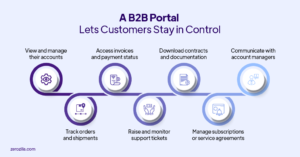
It integrates with backend systems like ERP, CRM, billing, inventory, and logistics platforms to provide real-time data.
But its true value isn’t technical. It’s relational.
1. Transparency Builds Trust
Trust is the bedrock on which any long-term B2B partnership is built.
Customers are bound to lose their cool when they have to email repeatedly for invoice copies or shipment updates. Delays create uncertainty. Uncertainty erodes trust.
A self-service portal eliminates information gaps by offering:
- Real-time order status
- Complete billing visibility
- Historical transaction records
- Clear contract details
- Account performance insights
Transparency reduces dependency. When clients see accurate information instantly, they feel confident in your operations.
And confidence strengthens relationships.
2. Faster Resolution Improves Satisfaction
Time is critical in B2B environments. A delayed shipment can impact production. A billing error can disrupt procurement cycles.
Traditional support workflows often involve:
- Customer sends email
- Support logs ticket
- Internal follow-up
- Status update sent later
With a self-service portal, customers can:
- Log tickets directly
- Track status in real time
- Access knowledge base articles
- Download troubleshooting guides
- See expected resolution timelines
This reduces friction and anxiety.
Even when issues aren’t resolved instantly, visibility into the process improves satisfaction dramatically.
Customers don’t just want solutions — they want clarity.
3. Empowerment Creates Stronger Partnerships
When does a B2B relationship become stronger? When customers feel empowered rather than dependent.
A self-service portal shifts the dynamic from “service provider vs. client” to “collaborative partnership.”
Customers can:
- Place orders anytime
- Modify quantities
- Reorder from history
- Update account details
- Access customized pricing
- Review performance metrics
When clients control routine actions, your teams can focus on strategic collaboration instead of administrative tasks.
Empowerment increases perceived value.
And perceived value deepens loyalty.
4. Personalization Enhances Engagement
Modern self-service portals are not static dashboards. They can be highly personalized based on:
- Industry
- Contract type
- Purchase behavior
- Pricing tiers
- Support plans
For example:
- A distributor may see bulk order tools.
- A subscription-based client may see renewal alerts.
- A high-value account may have direct account manager access.
Personalized dashboards create a sense of exclusivity and relevance.
Customers feel understood — not generalized.
This emotional component is often overlooked in B2B, but it plays a powerful role in relationship retention.
5. Reduced Friction Leads to Higher Retention
Customer churn in B2B rarely happens due to one dramatic event. It often stems from accumulated friction:
- Slow responses
- Repetitive communication
- Lack of visibility
- Manual processes
- Confusing billing
A self-service portal reduces micro-frustrations.
When processes become smoother, customers:
- Stay longer
- Increase order frequency
- Expand contracts
- Refer others
Retention improves not because you added features — but because you removed friction.
6. Data Insights Enable Proactive Engagement
One of the biggest relationship advantages of a self-service portal is data.
Every login, download, ticket, and transaction generates insights:
- What services are most used?
- Where do customers face issues?
- When do accounts log in most frequently?
- Which invoices are repeatedly disputed?
These insights allow businesses to move from reactive to proactive engagement.
Instead of waiting for complaints, you can:
- Offer upgrades
- Suggest optimized plans
- Alert customers about delays
- Recommend additional services
- Intervene before churn risk increases
Proactivity signals care.
And care strengthens relationships.
7. Scalability Without Losing Personal Touch
As B2B companies grow, maintaining personalized service becomes challenging.
Hiring more support agents isn’t always sustainable. Without digital systems, service quality may decline as customer volume increases.
Self-service portals allow businesses to scale efficiently while preserving relationship quality.
Routine inquiries are automated, while high-value conversations remain human-led.
Your team spends time on strategy, not status updates.
This balance ensures customers feel supported — not processed.
8. Improved Communication Channels
Modern portals often include integrated messaging systems that:
- Connect clients directly with account managers
- Centralize communication history
- Attach files to tickets
- Track discussion threads
This prevents fragmented email chains and lost context.
Centralized communication enhances clarity and reduces misunderstandings.
When communication improves, relationships improve.
9. Strengthened Brand Perception
Digital experience is now part of brand identity.
A professional, intuitive, secure self-service portal signals:
- Operational maturity
- Technological advancement
- Customer-first mindset
- Reliability
Conversely, outdated manual processes signal inefficiency.
In competitive B2B markets, experience differentiates as much as price.
A strong digital interface strengthens how customers perceive your brand — and perception directly impacts loyalty.
10. Security and Compliance Increase Confidence
B2B transactions involve sensitive data:
- Financial records
- Contracts
- Payment details
- Procurement information
A secure self-service portal with:
- Role-based access
- Multi-factor authentication
- Encrypted data
- Audit trails
Reinforces confidence.
When customers trust your data handling practices, the relationship deepens beyond transactions.
Security is not just IT hygiene — it’s relationship insurance.
11. Supporting Multi-Stakeholder B2B Environments
Unlike B2C, B2B accounts often involve multiple stakeholders:
- Procurement teams
- Finance departments
- Operations managers
- C-suite decision-makers
A self-service portal can provide role-based dashboards aligned specifically to each stakeholder.
For example:
- Finance sees invoices and payment history.
- Operations tracks shipments.
- Executives view performance metrics.
When every stakeholder has clarity, internal alignment improves and your partnership becomes stronger.
12. Encouraging Long-Term Collaboration
B2B relationships often last for years.
A self-service portal becomes a shared workspace between both companies.
Over time, it becomes:
- A record of collaboration
- A central hub of transactions
- A communication archive
- A performance tracker
Digital integration strengthens long-term partnership stability.
13. Cost Efficiency Beneficial to Both the Sides
Self-service portals reduce operational costs:
- Fewer support tickets
- Reduced manual processing
- Automated billing workflows
- Faster dispute resolution
Lower operational overhead allows businesses to:
- Maintain competitive pricing
- Reinvest in service innovation
- Improve customer experience
Cost efficiency isn’t just internal savings — it strengthens value perception for clients.
14. Competitive Differentiation in Saturated Markets
In many B2B industries, there is minimal product differentiation. Across vendors, pricing, delivery timelines, and specifications may remain similar.
Customer experience becomes the deciding factor.
A robust self-service portal:
- Speeds up transactions
- Simplifies procurement
- Reduces communication friction
- Enhances transparency
These advantages directly influence renewal decisions.
How to Generate Maximum Relationship Impact
To truly strengthen relationships, a self-service portal must be:
- User-Centric: Design around customer workflows — not internal structures.
- Integrated: Ensure real-time sync with ERP, CRM, inventory, and billing systems.
- Secure: Implement enterprise-grade security standards.
- Scalable: Plan for growth, additional modules, and evolving needs.
- Continuously Improved: Collect feedback and optimize regularly.
Technology alone doesn’t build relationships. Execution does.
Case Study: Custom B2B Self-Service Portal for Account Management by Zerozilla
Overview
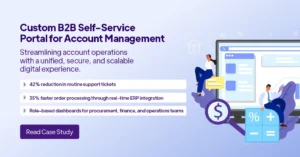
Zerozilla developed a custom B2B self-service portal for an enterprise facing delays and inefficiencies in account management. Manual processes for order tracking, invoicing, and support created friction and increased workload. The goal was to centralize account operations into a secure, scalable digital platform that improved visibility and strengthened customer relationships.
Solution
- Built a scalable, cross-platform web portal tailored to the client’s workflows
- Integrated ERP, CRM, billing, and inventory systems for real-time synchronization
- Enabled role-based dashboards for procurement, finance, and operations teams
- Implemented secure authentication and compliance-ready infrastructure
Features
- Centralized Dashboard: Unified view of orders, invoices, contracts, and tickets
- Order Management: Real-time order placement, tracking, and reordering
- Billing Access: Instant invoice downloads and payment tracking
- Support System: Ticket submission and status monitoring
- Role-Based Access: Customized views for multiple stakeholders
- Secure & Integrated: Real-time backend sync with strong security controls
Impact
- 42% reduction in routine support tickets
- 35% faster order processing
- Improved payment cycles through billing transparency
- Higher customer retention and stronger account engagement
Why It Matters
This case study shows how a custom B2B portal can eliminate friction, improve transparency, and elevate account management from reactive support to strategic partnership — driving both operational efficiency and long-term relationship growth.
The Future of B2B Relationships Is Hybrid
The goal of a self-service portal isn’t to eliminate human interaction.
It’s to elevate it.
Routine tasks become automated. Conversations become more meaningful.
Account managers stop blindly reacting to issues alone. Instead, they start helping customers plan ahead.
Support teams spend less time answering the same questions and more time solving real problems.
To Conclude
A self-service portal may begin as an operational efficiency project.
However, it has far more impact than just cost savings. It builds and elevates trust through transparency.
It increases satisfaction through speed.
It enhances the capabilities of customers through control.
It facilitates loyalty through frictionless experiences.
It drives proactive engagement through data insights.
In today’s competitive B2B landscape, relationships are built not only in boardrooms — but also through digital touchpoints.
A thoughtfully designed self-service portal doesn’t replace relationships.
It strengthens them.